We recently took on a client in the hygiene products niche who had a bit of a "blind spot" in their digital marketing. They were running Search, Shopping, and a PMax campaign that wasn't pulling its weight, but the real kicker? They had no conversion tracking in place.
They were spending real budget across three campaign types with no idea into which products were generating revenue, which clicks were converting, or where every dollar was actually going. Without that data, the campaigns had no foundation to optimise from, and the PMax campaign in particular was left to run on guesswork.
Our first priority was to stop the guesswork. We implemented full purchase tracking with conversion values so we could see exactly which products were driving revenue. Once the data started flowing, we rebuilt the strategy from the ground up rather than patching what was already there.
Rather than letting the existing PMax campaign continue running across the full product catalogue with no signal to work from, we created a dedicated "Selected Products" PMax campaign. By limiting which products were included and grouping them deliberately, we gave the algorithm a tighter brief and a higher-quality audience to learn from. This product segmentation was one of the most impactful structural changes we made.
We analysed the demographic data and identified age groups that were consuming budget without converting. Those segments were excluded outright. Hygiene products have a fairly defined buyer profile, and letting Google serve ads broadly across all age groups was a significant source of wasted spend. Tightening this alone had an immediate effect on efficiency.
A comprehensive negative keyword list was built to block irrelevant search queries from triggering ads. In a category like hygiene products, broad or ambiguous searches can attract a wide range of unqualified traffic. Cutting that out meant the remaining clicks were significantly more likely to convert.
We reviewed when conversions were actually occurring and set up ad scheduling to concentrate spend during peak periods. Running ads at full spend around the clock in a low-budget account is an easy way to drain the daily cap before the highest-intent traffic arrives. Scheduling addressed that directly.
We worked through the product feed to sharpen titles, descriptions, and images to better match buyer search intent and improve click quality. Alongside that, we resolved a series of policy issues that had been suppressing product eligibility and limiting how broadly the Shopping and PMax campaigns could serve.
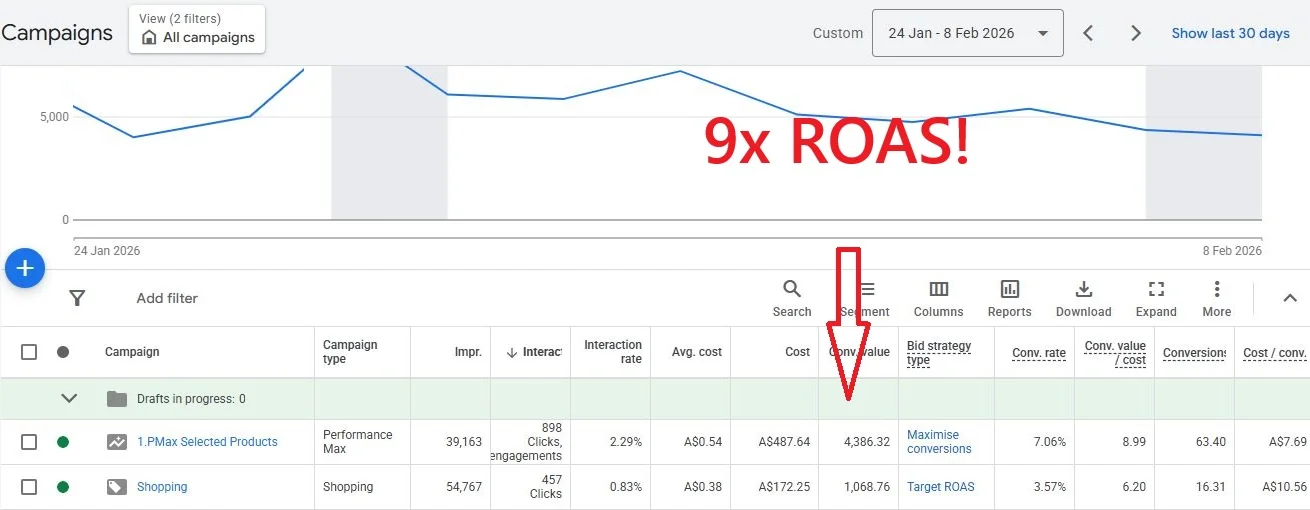
The new PMax campaign went live in late January 2026. Within the first two weeks (24 Jan to 8 Feb), it delivered an 8.99 ROAS on A$487.64 in spend, generating A$4,386.32 in conversion value. That early signal confirmed the account rebuild was working.
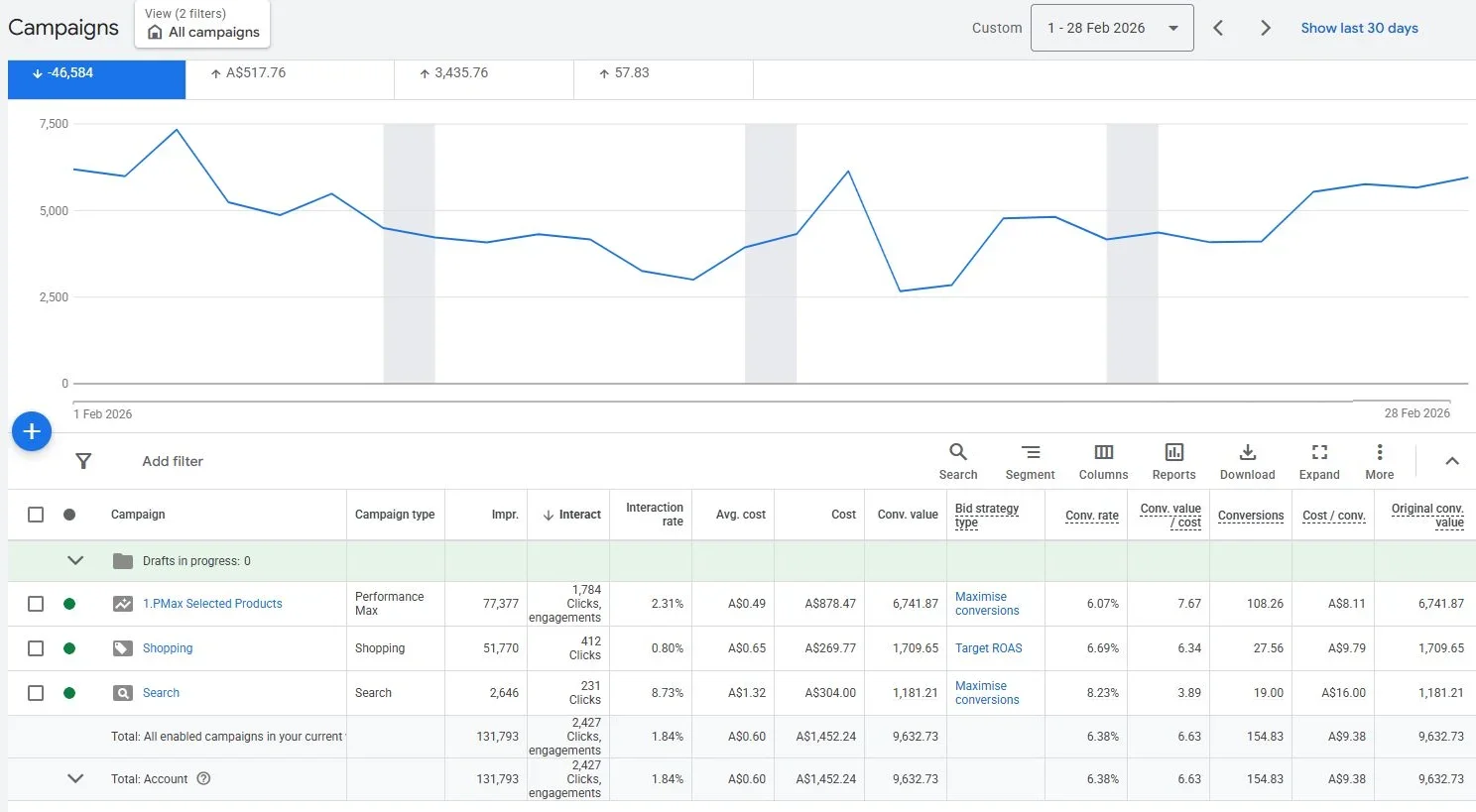
By the end of February, with all three campaigns running under the new structure, the entire account was humming:
Conversion tracking is the non-negotiable starting point for any serious e-commerce account. Without it, spend has no direction. Once the data foundation was in place, a focused PMax rebuild and feed optimisation drove a 7.67x ROAS within a single month. Granular segmentation, negative keywords, and demographic exclusions kept spend efficient. Both top campaigns ending the month budget-limited signals genuine room to scale further.
| Campaign | ROAS | Conv. Rate | Conv. Value |
|---|---|---|---|
| PMax Selected Products | 7.67 | 6.07% | AU$6,741.87 |
| Standard Shopping | 6.34 | 6.69% | AU$1,709.65 |
| Search | 3.89 | 8.23% | AU$1,181.21 |
| Total Account | 6.63 | 6.38% | AU$9,632.73 |
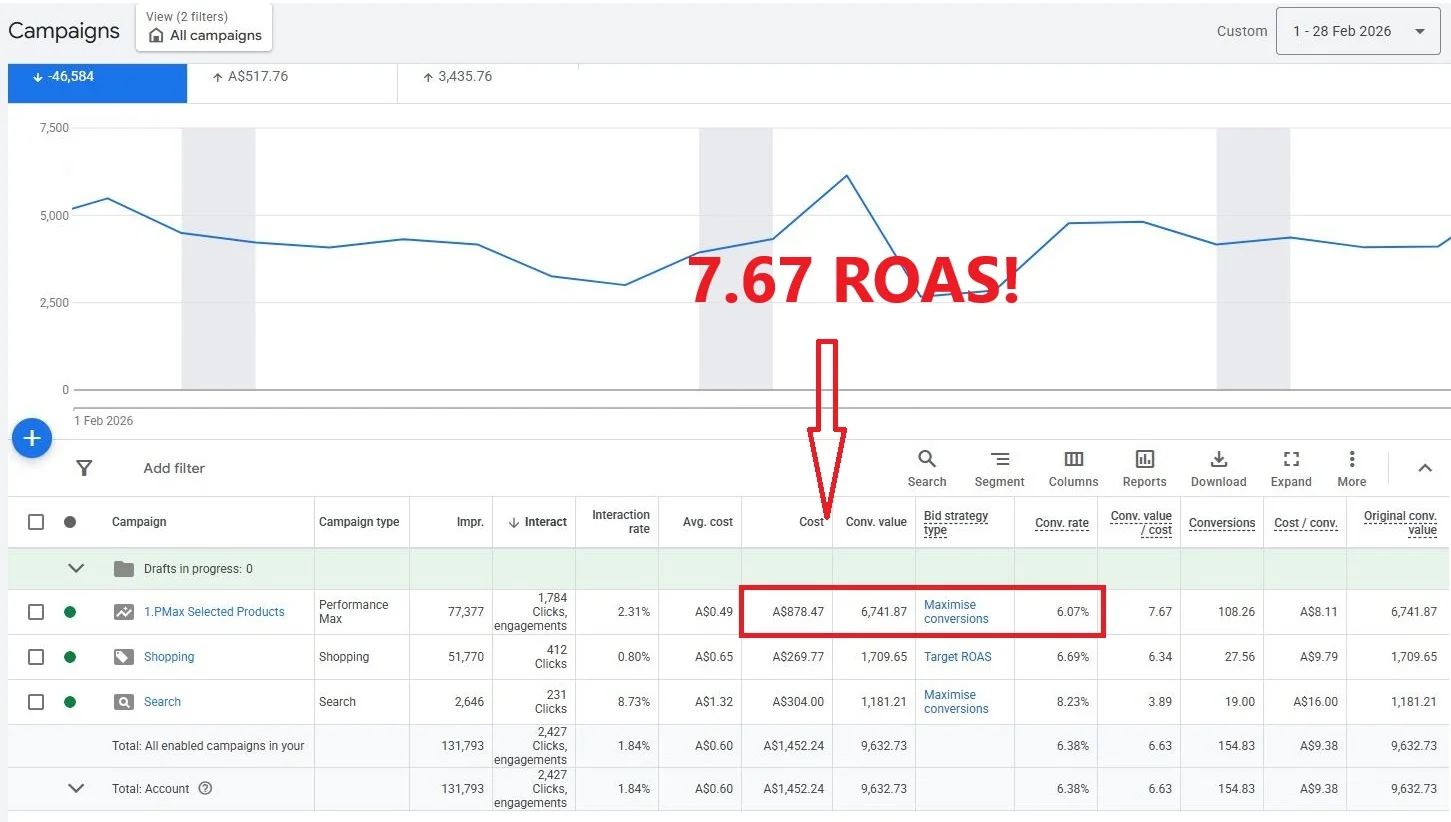
By moving away from a "set and forget" approach and focusing on strict segmentation and data-driven targeting, we turned a fragmented account into a high-yielding revenue engine. AU$9,632.73 in tracked revenue from AU$1,452.24 in spend, in month one, with both primary campaigns constrained only by daily budget rather than by performance.
 0413 107 893