 0413 107 893
Quality Score is Google's 1-to-10 rating of how relevant your keyword, ad copy, and landing page are to the searcher's intent. It is one of the most misunderstood metrics in paid search, yet it has a direct, measurable impact on what you pay per click and where your ads appear.
This guide explains how Quality Score works, what drives it up or down, how it connects to Ad Rank, and what practical steps produce genuine improvement across a Google Ads account.
What Is Quality Score?
Quality Score is calculated at the keyword level and is composed of three components, each rated Below Average, Average, or Above Average:
- Expected Click-Through Rate (CTR): Google's prediction of how likely your ad is to be clicked when shown for a given keyword, based on historical data.
- Ad Relevance: how closely your ad copy matches the intent behind the keyword being searched.
- Landing Page Experience: Google's assessment of how useful, relevant, and easy to navigate your landing page is for someone who clicks the ad.
A score of 10 means all three components are rated Above Average. A score of 1 means one or more components are seriously underperforming. Most accounts sit in the 4-6 range by default, which means they are paying a significant premium for every click.
Why Quality Score Matters: Ad Rank and Cost Per Click
Quality Score feeds directly into Ad Rank, which determines both your ad position and your actual CPC. The simplified formula is:
Ad Rank = Max CPC Bid x Quality Score x Expected Impact of Extensions
The practical consequence is significant. Two advertisers bidding the same amount will pay different prices and appear in different positions based on their Quality Scores. The advertiser with the higher score wins better placement at a lower cost.
| Advertiser | Max Bid | Quality Score | Ad Rank | Estimated CPC |
|---|---|---|---|---|
| Advertiser A | A$5.00 | 8 | 40 | A$2.80 |
| Advertiser B | A$5.00 | 4 | 20 | A$4.60 |
| Advertiser C | A$8.00 | 3 | 24 | A$4.90 |
Advertiser A wins top position at the lowest cost, not because they bid more, but because their relevance signals are stronger. This is the compounding benefit of a well-structured account.
In practice, this is what we observed with clients like Junk Removalist Perth and Perth Ceiling Fixers. When managing Google Ads Perth accounts, we saw both accounts had reasonable budgets but were paying well above market rates per conversion. Rebuilding the account structure, tightening keyword-to-ad alignment, and improving landing page relevance produced significant CPA reductions without increasing spend.
The Three Pillars of Quality Score
1. Expected Click-Through Rate
CTR is a measure of how compelling and relevant your ad appears before someone clicks. Google's prediction is based on prior performance for your keyword and match type, adjusted for ad position.
The most effective ways to improve expected CTR are:
- Use exact match or tightly themed phrase match keywords rather than broad match in early campaign stages. Broad match casts a wide net and often triggers your ads for irrelevant queries, pulling down your CTR average.
- Write headlines that mirror search intent precisely. If the keyword is 'ceiling fixer Perth', the first headline should say exactly that.
- Use all available ad extensions: sitelinks, callouts, structured snippets, and call extensions. These expand ad real estate and improve click rates meaningfully.
- Maintain a tight negative keyword list to prevent your ads from showing for off-topic queries.
Perth Ceiling Fixers had a CTR of 4.11% before their account was rebuilt. After restructuring ad groups and rewriting copy around specific service themes, both CTR and conversion rate improved substantially, ultimately reaching 50 leads per month from a starting point of 3.
2. Ad Relevance
Ad relevance measures how well your ad copy addresses the intent behind the keyword. Google is evaluating whether your ad would be a satisfying answer to someone searching that term.
The most important principle here is one theme per ad group. When an ad group contains a mix of loosely related keywords, no single ad can be fully relevant to all of them. The result is an Ad Relevance rating that hovers at Average or Below Average regardless of how well the individual ads are written.
Practical steps to improve ad relevance:
- Structure ad groups around tightly themed keyword clusters, ideally two to five keywords with the same intent.
- Include the primary keyword in Headline 1, either manually or via keyword insertion.
- Write descriptions that address the underlying need, not just repeat the keyword. Someone searching 'emergency plumber Perth' wants reassurance about speed and availability, not just a headline that says 'Emergency Plumber Perth'.
- Review the Search Terms Report regularly and exclude queries that are triggering your ads for unintended reasons.
When we restructured the Junk Removalist Perth account, campaigns were broken out by service type and location. Each ad group spoke directly to the specific removal query rather than relying on a single catch-all campaign to cover all variations. This structural change is what made improved ad relevance possible.
3. Landing Page Experience
Landing page experience is assessed by Google's crawler and by user behaviour signals. A page that loads slowly, fails on mobile, or does not deliver on the promise made in the ad will score poorly regardless of how relevant the keyword and ad copy are.
Google evaluates:
- Whether the page content matches the ad and keyword. If the ad says 'Get a Free Quote' and the landing page has no quote form, that is a mismatch.
- Page load speed and Core Web Vitals performance.
- Mobile usability, including tap target size, scroll depth to reach the CTA, and overall layout.
- Content clarity and transparency. Pages that are thin on content, use deceptive copy, or make it difficult to understand what the business does will score poorly.
The most impactful change most accounts can make here is to stop sending all traffic to the homepage. A campaign about shower resealing should land on a page about shower resealing, not a general services overview.
For Re-Seal Shower and Tiling, landing page copy was rewritten with exact-match keyword placement aligned to each ad group's theme. The copy changes alone moved Quality Scores measurably by improving the relevance signal between the page content and the keywords triggering each ad.
Account Structure: The Foundation
Even well-written ads cannot achieve high Quality Scores when the account structure is poor. Structure determines whether relevance is even possible at the keyword level.
A well-structured account follows this pattern:
- Campaign: organised by product, service, or geography.
- Ad group: a single keyword theme with two to five closely related keywords.
- Ads: one Responsive Search Ad per ad group, written specifically for that theme.
- Landing page: one per campaign or ad group theme, with copy that mirrors the keyword's intent.
National Property Valuers is a clear example of what structural change delivers. The original account was one campaign covering the whole country. After rebuilding with individual campaigns per major Australian city, keyword-to-ad alignment tightened at every level, contributing directly to a conversion rate increase from 3% to 24.65% in six weeks.
Responsive Search Ads and Quality Score
RSAs give Google flexibility to test headline and description combinations. This can help or hurt Quality Score depending on how the assets are written.
Key points to keep in mind:
- Include the primary keyword in at least two headlines so Google has a strong relevance signal to work with regardless of which combination it tests.
- Write eight to fifteen meaningfully distinct asset variations. Filler assets that say the same thing in slightly different words dilute the relevance signal.
- Pin Headline 1 if keyword consistency is critical for the ad group's relevance score.
- Ad Strength and Quality Score are different metrics. Ad Strength rewards variety; Quality Score rewards relevance. Optimising purely for Ad Strength can sometimes hurt Quality Score.
How to Get a 10 Quality Score for Keywords in Google Ads
Quality Score data is available in the Keywords tab in Google Ads by adding the relevant columns. Each of the three components can be viewed individually, which makes diagnosis straightforward.
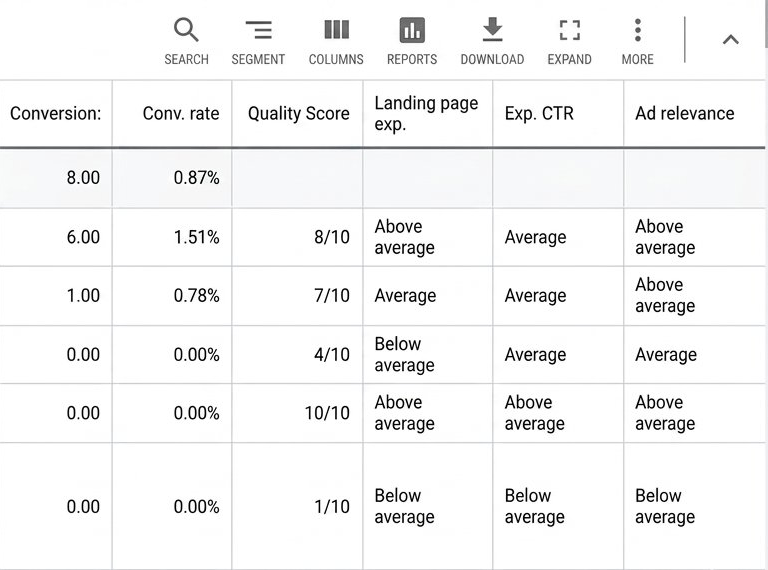
Quality Score is a lagging indicator. It reflects historical performance, so improvements take time to register. A keyword with a long history of poor CTR will not jump to a 10 overnight even after fixing the underlying issues. Expect meaningful movement within 30 to 60 days of making structural and copy changes.
| Component | Below Average Diagnosis | Action |
|---|---|---|
| Expected CTR | Ads not being clicked relative to impressions | Review match types, rewrite headlines, add extensions, audit negatives |
| Ad Relevance | Ad copy does not match keyword intent | Restructure ad groups, rewrite RSA assets to target specific theme |
| Landing Page Experience | Page does not deliver on ad promise | Build dedicated landing pages, improve page speed, align copy to keyword |
Keywords with persistently low scores (1 to 3) that have accrued significant impression history are worth pausing. A long track record of poor performance is difficult to overcome, and those keywords can drag down the relevance signals for the rest of the ad group.
Here’s a simple checklist for your own diagnosis:
- Audit Quality Scores across the account. Identify all keywords scoring below 6 and note which component is rated Below Average.
- Restructure ad groups around single keyword themes. If an ad group has more than five keywords with meaningfully different intent, split it.
- Rewrite RSA assets to mirror the keyword intent in Headline 1. Ensure descriptions address the specific need, not a generic offer.
- Build or update landing pages with copy that matches the keyword theme, a clear CTA above the fold, and fast load times on mobile.
- Run the Search Terms Report and add negatives before the next campaign review.
- Set a 30-day calendar reminder to review the Quality Score columns. Track changes per component, not just the overall score.
- After 60 days, pause keywords that have not responded to remediation and replace with tighter, more specific alternatives.
Conclusion
It’s easy to think that Quality Score might just be another vanity metric, but it is not. It is the mechanism by which Google rewards relevance and penalises lazy account management. A score of 10 is achievable with the right structure, copy, and landing page working in alignment.
The accounts that improve most are not those that increase their budgets, but those that get the fundamentals right: one theme per ad group, ad copy that speaks directly to search intent, and landing pages that deliver on the ad's promise. The efficiency gains compound quickly, reducing CPA while improving position.
If your account has keywords stuck in the 3-5 range and a CPA that does not reflect your actual offer, the Quality Score components are almost always where the problem starts.