Conversion Accuracy is Everything. Here's what happens when you build measurement from scratch and finally get it right.
In mid-February 2026 we took over the Google Ads account for a chiropractic practice in Duncraig, Perth. The campaigns were running — spend was going out, clicks were coming in — but there was no conversion tracking set up whatsoever. No calls tracked. No form submissions. No bookings attributed. The business had no way to know whether any of it was working.
That was problem one. Problem two was the ad copy: it contained language that directly violated AHPRA advertising guidelines — prohibited comparative claims and implied treatment guarantees that exposed the practitioner to formal complaints.
This case study documents what we built, what we measured, and how the numbers changed once we could actually trust them.
The account had been running without any conversion tracking. There was no way to attribute bookings, calls, or form submissions to specific ads or campaigns. This means the previous budget had been allocated entirely on guesswork — there was no performance data to guide any decision. Before any optimisation was possible, we needed to understand what was actually happening.
The existing ad copy violated AHPRA advertising guidelines under Section 133 of the Health Practitioner Regulation National Law. Specifically, we identified comparative claims implying superiority over other practitioners, and language suggesting guaranteed treatment outcomes — both of which are prohibited. In regulated healthcare advertising, this is not a style issue; it is a compliance risk. The practitioner carries personal liability for non-compliant advertising, regardless of whether it was placed by an agency on their behalf. We paused and rewrote the ads before doing anything else.
Duncraig Chiro uses Cliniko as their online booking platform. Cliniko is a third-party system hosted on a separate domain, which means standard Google Ads conversion tracking — which relies on a thank-you page on the same domain — cannot track completed bookings without a custom cross-domain implementation. Setting this up properly requires GTM's linker configuration to pass the Google Ads click ID (gclid) through the Cliniko booking flow. As an interim solution while we built and validated this, we configured a booking button click as our initial conversion action — a proxy metric that at least gave the algorithm something to work with while real tracking was being established.
We rewrote all ad copy to meet AHPRA's advertising obligations — removing comparative claims, removing any language that implies guaranteed outcomes, and reviewing ad extensions and landing page content. AHPRA compliance applies to the entire advertising chain, not just the headline. This came before any performance work.
With compliance addressed, we set up an initial conversion action: a booking button click. This was a proxy — not an accurate measure of actual appointments — but it gave the campaigns a signal to optimise toward while we built the proper cross-domain solution. The data from this period is useful for volume and structure analysis, but the conversion rate it produced cannot be taken at face value.
We deployed cross-domain conversion tracking via Google Tag Manager within the first month. The GTM linker configuration passes the gclid parameter through the Cliniko booking domain, allowing us to attribute completed booking steps back to specific ad clicks. This is the tracking that made Period 2 data meaningful. Approximately 25% of conversions remain unattributed due to Cliniko's booking flow — something we continue to work on.
Once we had reliable conversion data, we rebuilt the bidding strategy around it, refined keyword match types, expanded the negative keyword list (particularly important in healthcare to exclude informational and symptom-research queries), and adjusted ad scheduling based on practice booking patterns.
With our initial booking button click tracking in place, the account reported a 30.28% conversion rate and 178 conversions. These numbers reflect our interim proxy setup — every click on the "Book Now" button was counted as a conversion, regardless of whether the user completed a booking.
The Suburbs campaign in particular showed a 45.62% "conversion rate" — mathematically consistent with a click-based trigger. This data helped us understand campaign structure and traffic volume, but we couldn't optimise toward it. A click is not a booking.
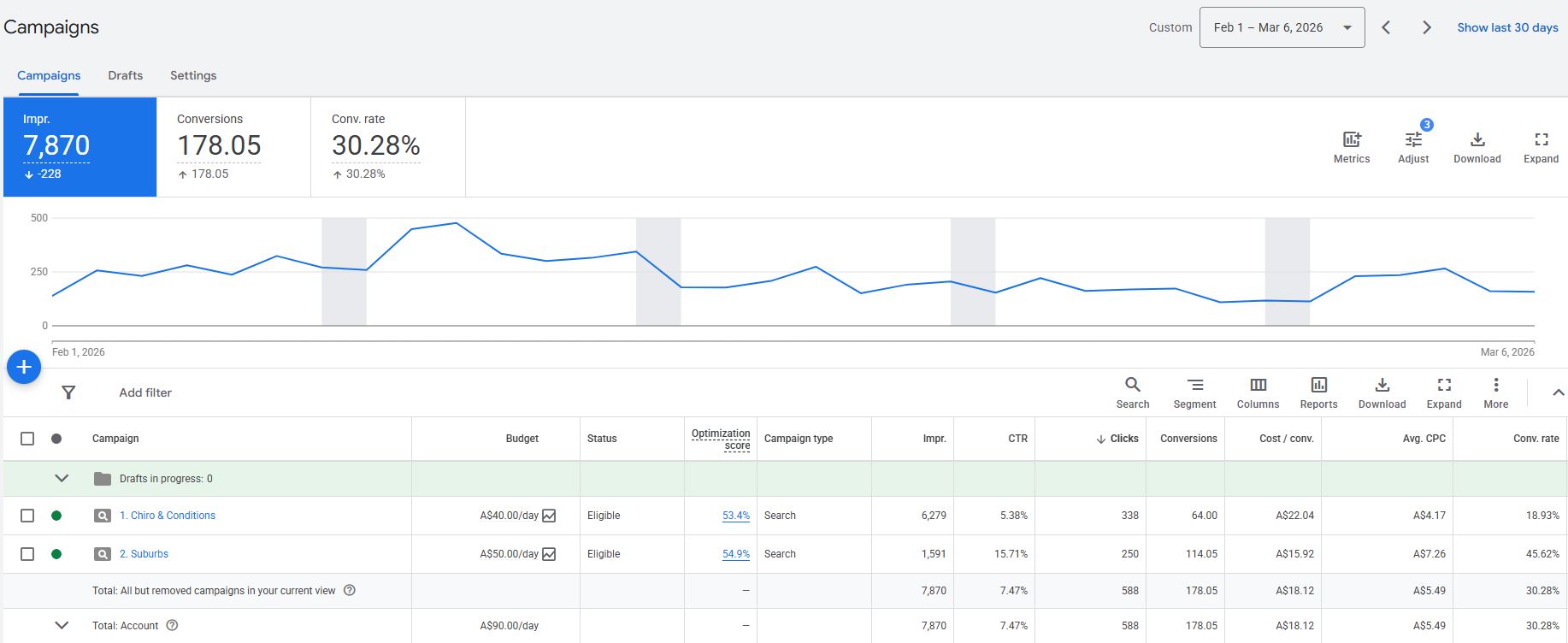
| Campaign | Impressions | Clicks | Conv. | Conv. Rate | Cost / Conv. | CPC |
|---|---|---|---|---|---|---|
| Total | 7,870 | 588 | 178.05 | 30.28% | A$18.12 | A$5.49 |
| Chiro & Conditions | 6,279 | 338 | 64.00 | 18.93% | A$22.04 | A$4.17 |
| Suburbs | 1,591 | 250 | 114.05 | 45.62% | A$15.92 | A$7.26 |
With cross-domain tracking live, the conversion rate settled at 6.42%. This was the first accurate read of the account. We were now measuring real booking intent — not button clicks.
A 6.42% conversion rate for a healthcare service in a competitive Perth suburb is a meaningful baseline. The cost per conversion — A$92.35 — represents the genuine cost to acquire a patient enquiry, and for the first time we could evaluate it against actual patient lifetime value.
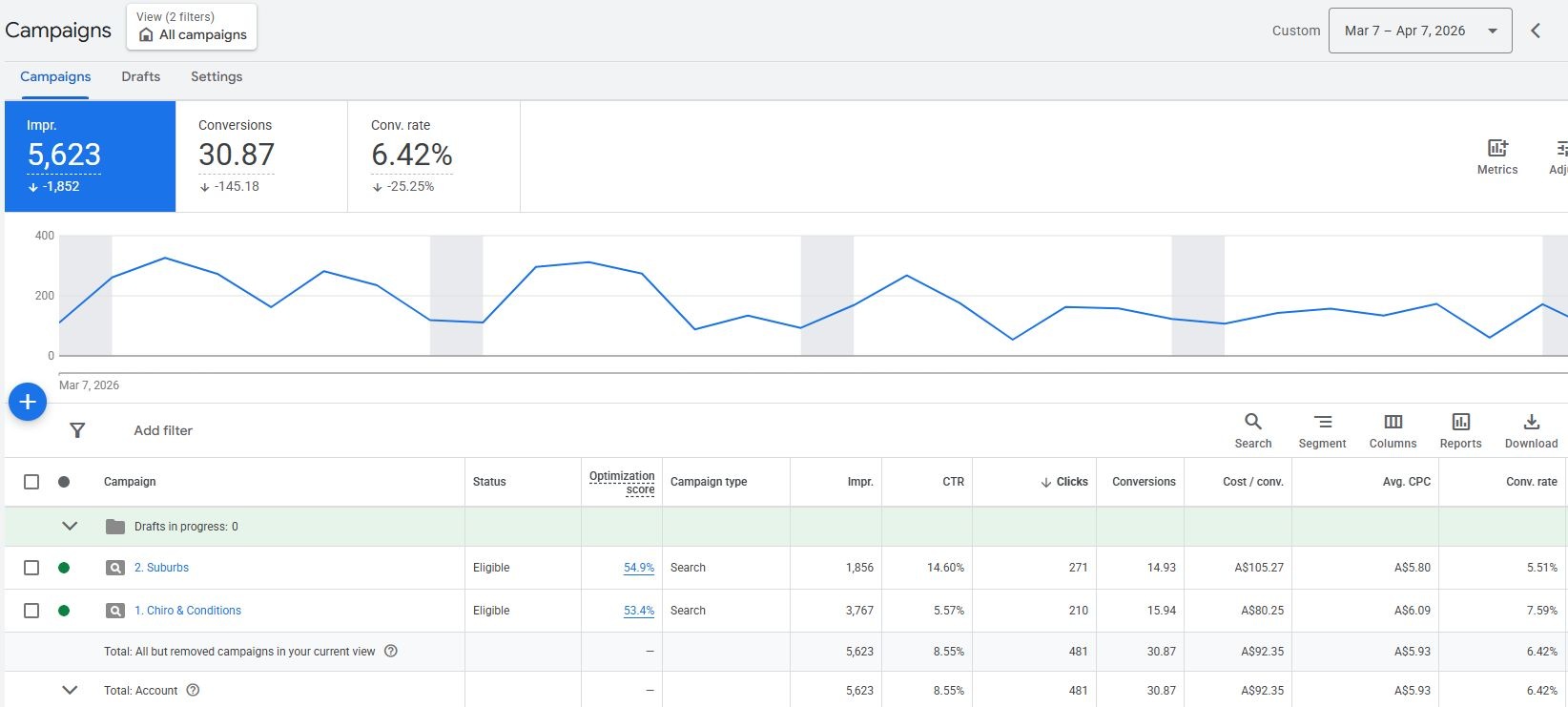
| Campaign | Impressions | Clicks | Conv. | Conv. Rate | Cost / Conv. | CPC |
|---|---|---|---|---|---|---|
| Total | 5,623 | 481 | 30.87 | 6.42% | A$92.35 | A$5.93 |
| Chiro & Conditions | 3,767 | 210 | 15.94 | 7.59% | A$80.25 | A$6.09 |
| Suburbs | 1,856 | 271 | 14.93 | 5.51% | A$105.27 | A$5.80 |
After a month of optimising with real data, the conversion rate climbed to 11.96% and cost per conversion dropped from A$92.35 to A$59.82 — a 35% improvement in one month.
The Chiro & Conditions campaign reached 17.63%, reflecting better keyword-to-ad-to-landing-page alignment and a tighter negative keyword set. The Suburbs campaign is lower but still improving.
With approximately 25% of conversions still unattributed due to Cliniko's booking flow architecture, the estimated true conversion rate is closer to 15%. This attribution gap remains an active area of work.
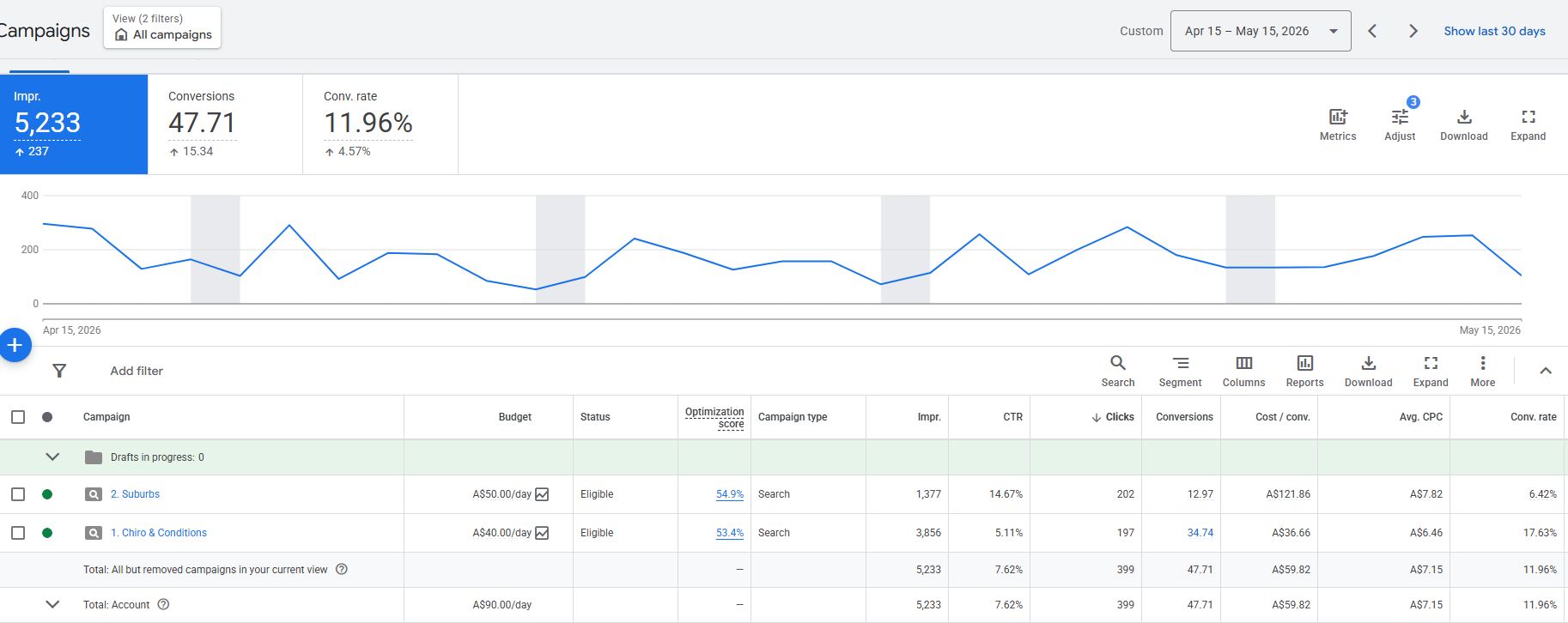
| Campaign | Impressions | Clicks | Conv. | Conv. Rate | Cost / Conv. | CPC |
|---|---|---|---|---|---|---|
| Total | 5,233 | 399 | 47.71 | 11.96% | A$59.82 | A$7.15 |
| Chiro & Conditions | 3,856 | 197 | 34.74 | 17.63% | A$36.66 | A$6.46 |
| Suburbs | 1,377 | 202 | 12.97 | 6.42% | A$121.86 | A$7.82 |
Three periods. Three very different stories — because the measurement changed.
| Period | Dates | Clicks | Conv. Rate | Conversions | Cost / Conv. | Tracking |
|---|---|---|---|---|---|---|
| Period 1 | Feb 1 – Mar 6 | 588 | 30.28% | 178.05 | A$18.12 | Button click proxy |
| Period 2 | Mar 7 – Apr 7 | 481 | 6.42% | 30.87 | A$92.35 | Cross-domain GTM |
| Period 3 | Apr 15 – May 15 | 399 | 11.96% | 47.71 | A$59.82 | Cross-domain GTM (~15% est. true) |
AHPRA-regulated practitioners bear personal liability for their advertising. A non-compliant campaign is a registration risk. We address this first, before any performance work.
Running ads without conversion tracking is spending budget with no feedback loop. You cannot optimise what you cannot measure. Setting up measurement was the foundation that made everything else possible.
Any healthcare practice using Cliniko, HotDoc, Power Diary, or similar third-party booking systems cannot rely on standard conversion tracking. The gclid must be passed cross-domain via GTM. Most agencies don't do this because it is harder to set up.
The drop from 30% to 6% was not a decline — it was the moment we started measuring something real. The 6% built into 12% in one month. That trajectory is what matters.
| Metric | At Takeover | After Tracking Fix | Month 3 |
|---|---|---|---|
| Conv. Rate (reported) | — | 6.42% | 11.96% |
| Est. True Conv. Rate | Unknown | ~6.42% | ~15% |
| Conversion Tracking | None | Cross-domain GTM | Cross-domain GTM |
| AHPRA Compliant | No | Yes | Yes |
| Cost / Conversion | — | A$92.35 | A$59.82 |
We specialise in Google Ads for healthcare practitioners — including AHPRA compliance, cross-domain booking tracking for Cliniko, HotDoc and similar platforms, and campaign optimisation within regulated advertising constraints.
 0413 107 893