 0413 107 893
If you run Dynamic Search Ads, AI-created assets, or campaign-level broad match, Google is upgrading your campaigns to AI Max whether you opt in or not. The auto-upgrades are already rolling out, and Google expects all eligible campaigns to be moved by the end of September 2026.
For some accounts this will be a non-event. For others, it will quietly change which searches trigger your ads, what your ads say, and which pages people land on. If nobody is watching your account when the switch happens, you may only notice when the monthly invoice looks wrong.
Here's what's changing, and what to check.
What AI Max actually does
AI Max bundles three automation features into Search campaigns.
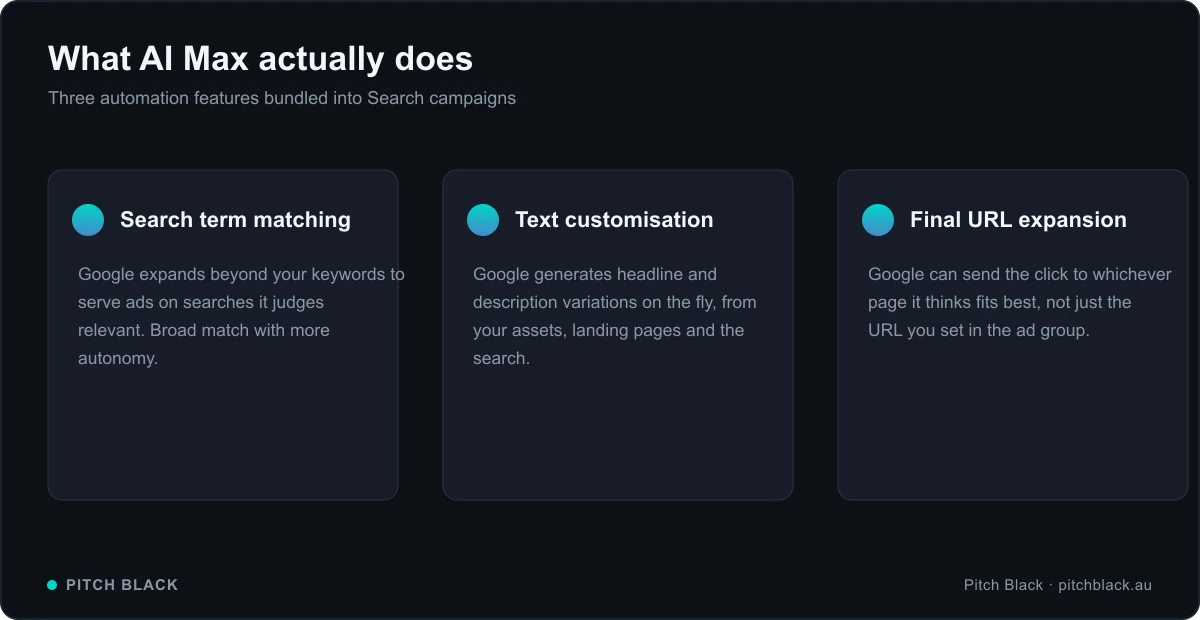
Search term matching. Google expands beyond your keywords to serve your ads on searches it considers relevant. Think of it as broad match with more autonomy.
Text customisation. Google generates headline and description variations on the fly, based on your existing assets, your landing pages, and the user's search.
Final URL expansion. Google can send the click to whichever page on your site it judges most relevant, not just the URL you set in the ad group.
Each of these can help or hurt, depending on how your account and website are set up. That's the whole story of AI Max. It amplifies the quality of your inputs. Clean conversion tracking, tight landing pages and well-structured assets get amplified. Messy tracking and a bloated website get amplified too.
What happens during the forced upgrade
Google has confirmed how the migration works.
- Dynamic Search Ads campaigns transition to standard ad groups with all three AI Max features enabled and your existing URL controls preserved.
- Automatically created assets users get upgraded with search term matching and text customisation on by default.
- Campaign-level broad match users get search term matching enabled by default.
The word "default" is doing a lot of work in those sentences. Enabled by default means enabled until you check.
Five things to check in your account now
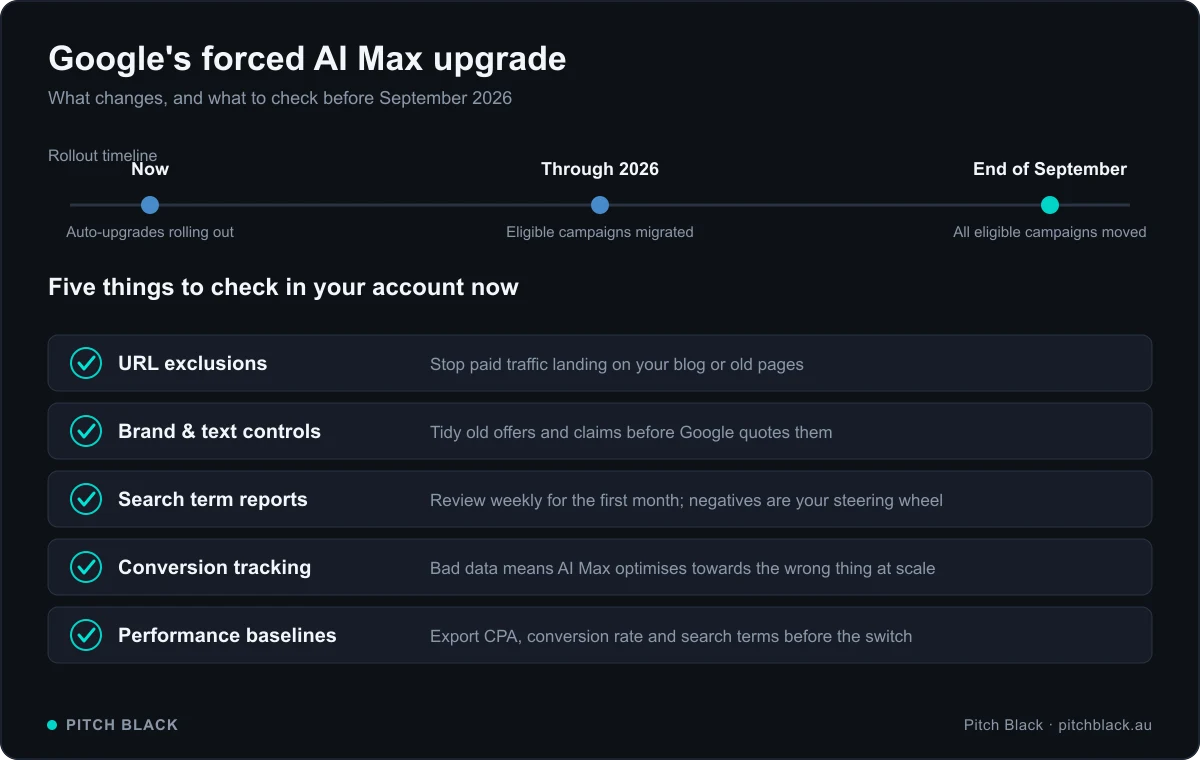
1. URL exclusions. If final URL expansion is on, Google can route paid traffic to your blog, your careers page, or an out-of-date service page. Exclude every URL that shouldn't receive paid clicks before the upgrade, not after.
2. Brand and text controls. AI-generated ad text pulls from your website. If your site contains old offers, discontinued services or claims you can no longer make, that copy can surface in live ads. Tidy the source before Google starts quoting it. For regulated industries this is not optional. See our guide to AHPRA rules and Google Ads for medical practices.
3. Search term reports. After the switch, review search terms weekly for at least the first month. AI Max's expanded matching will find genuinely useful queries you never bid on, and it will also find rubbish. Negatives are your steering wheel.
4. Conversion tracking. Automated bidding and matching are only as smart as the conversion data feeding them. If your tracking counts page views as leads, or misses phone calls entirely, AI Max will optimise towards the wrong thing at scale.
5. Performance baselines. Screenshot or export your pre-upgrade cost per acquisition, conversion rate and search term mix. When performance shifts in October, you'll want to know whether it was AI Max, seasonality, or something else.
Should you fight the upgrade or lean into it?
For most Australian small and medium businesses, fighting automation is a losing game. Google has been removing manual levers for years, and this is one more step. The right response is not resistance, it's supervision. AI Max with tight URL exclusions, disciplined negatives and accurate conversion tracking generally performs well. AI Max left unattended in a messy account burns budget with impressive efficiency.
The advertisers most at risk are the ones whose accounts nobody has opened since March. If that sounds uncomfortably familiar, the weeks before September are the time to fix it.
Get your account checked before Google moves it
We've been managing accounts through every one of Google's forced migrations since 2016. Enhanced campaigns, expanded text ads, the responsive search ad switchover. The pattern is always the same. Prepared accounts barely notice. Unprepared accounts bleed for a quarter.
If you'd like a second pair of eyes on your setup before the upgrade lands, our Google Ads management Perth service starts at $499 per month with no lock-in contracts, and we'll audit your AI Max readiness as part of onboarding. If you're comparing providers first, here's why clients rate us the best Google Ads agency in Perth.