 0413 107 893
Google Ads is one of the most effective channels for medical and allied health practices. People search for a physio, dentist or GP at the exact moment they need one. It's also one of the easiest places to breach AHPRA's advertising rules without realising, because the platform keeps suggesting copy, extensions and automated features that a regulated health service can't safely use.
This guide covers what the rules actually say, and how they apply to paid search specifically. It's general information, not legal advice. For the source material, see AHPRA's advertising hub at ahpra.gov.au.
The rules in one paragraph
Section 133 of the Health Practitioner Regulation National Law governs advertising of regulated health services. Your Google Ads, your landing pages, your Google Business Profile and your social media all count as advertising. The rules apply across every AHPRA-regulated profession, from doctors and dentists to physios, psychologists, chiropractors and optometrists. They apply to the business doing the advertising, even when a marketing agency wrote the copy. Penalties reach $30,000 per offence for individuals and $60,000 for corporations, and AHPRA processes hundreds of advertising complaints every year.
What you can and can't say
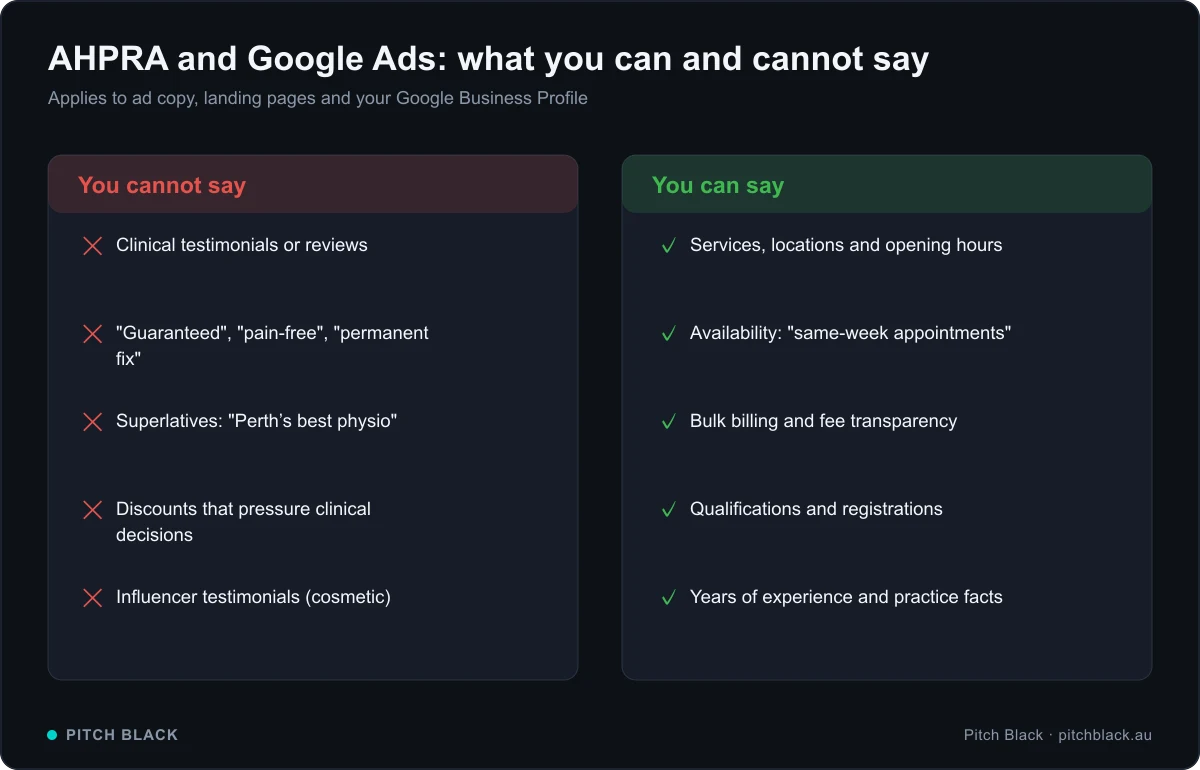
No clinical testimonials. This is the rule most practices break. You cannot use recommendations or positive statements about the clinical aspects of your service in advertising. Not in ad copy, not on the landing page, not as review snippets on your site. "Dr Smith cured my back pain" is prohibited. The ban covers clinical content specifically. A review praising your friendly reception or easy parking is not a clinical testimonial. Reviews on independent third-party platforms are also treated differently from reviews you republish in your own advertising. The moment you copy one onto your landing page, you've used it in advertising.
No misleading or unsubstantiated claims. Anything that creates unreasonable expectations of beneficial treatment is out. "Guaranteed results", "pain-free", "permanent fix". All of it is high-risk phrasing, regardless of how well your treatments work.
No superlatives without objective evidence. "Perth's best physio" and "the leading dental clinic in WA" are exactly the kind of statements AHPRA flags, because "best" can't be substantiated. This one stings for marketers, since superlative copy is standard practice in every other industry.
Careful with offers and urgency. Time-limited discounts that pressure people into clinical decisions are restricted. "50% off this week only" is normal retail copy and a problem in healthcare.
Cosmetic procedures have their own, stricter regime. Since September 2025, higher-risk non-surgical cosmetic procedures are covered by dedicated AHPRA guidelines, including an outright ban on influencer testimonials. If you advertise cosmetic work, treat that guidance as a separate compliance project.
Where Google Ads makes compliance harder
Three platform features deserve special caution.
Automatically created assets and AI Max. Google now generates ad text from your website content, and is auto-upgrading eligible campaigns to AI Max through 2026. For most businesses that's fine. For a regulated health service, it means Google can assemble sentences you never wrote and never reviewed. If any page on your site contains a patient quote or an outcome claim, that text can surface in a live ad. Our advice for medical accounts is simple. Keep AI-generated text features off, or audit every page Google can draw from.
Review extensions and seller ratings. Star ratings and review snippets appearing alongside health service ads can count as testimonial use. Don't enable review-based assets for regulated services.
Final URL expansion. If Google can pick your landing page, it can send paid traffic to a blog post or old page that hasn't been through compliance review. Lock down your URLs.
What you can say
Compliant ads aren't weak ads. You can state your services, locations, opening hours and availability, like "same-week appointments". You can state bulk billing or fee transparency, practitioner qualifications and registrations, years of experience, and factual practice details. In our experience managing healthcare accounts since 2016, factual, specific copy performs well. Something like "Physiotherapy in Joondalup. Open Saturdays. No referral needed." People searching for healthcare respond to clarity and availability more than hype. They skim the ad and decide on the landing page anyway. What matters is matching the search and removing friction.
The safe workflow
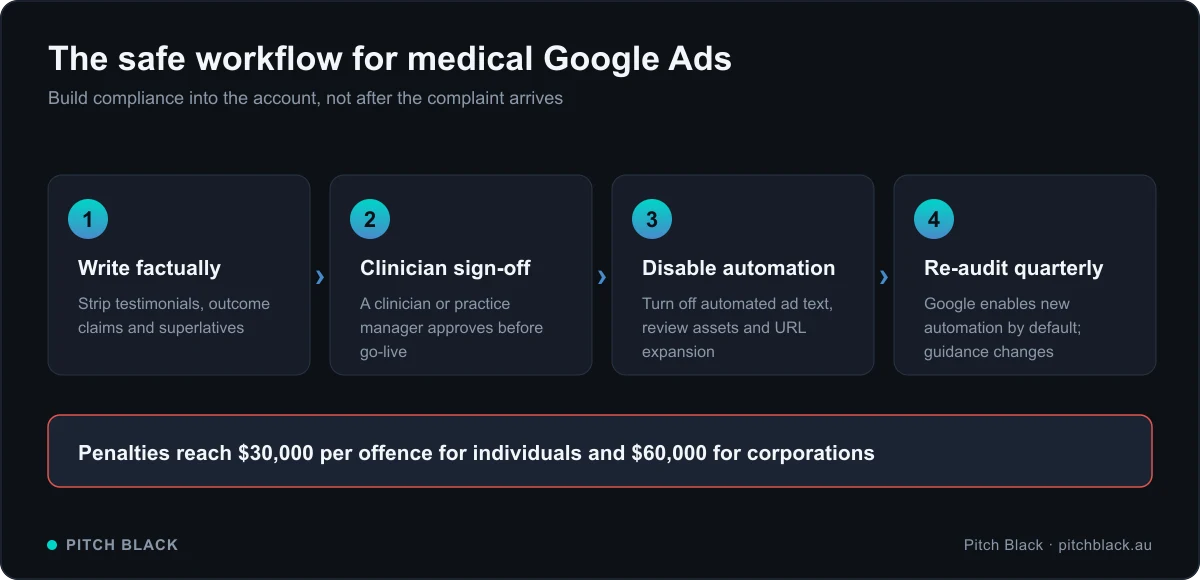
- Write ads and landing pages factually. Strip testimonials, outcome claims and superlatives.
- Have a clinician or practice manager sign off before anything goes live.
- Disable automated ad text, review assets and URL expansion.
- Re-audit quarterly. Google enables new automation by default, and AHPRA updates its guidance.
Need an agency that already knows these rules?
Most Google Ads agencies learn AHPRA compliance at your expense, after the complaint arrives. We've managed campaigns for healthcare practices since 2016, and we build compliance into the account from day one. Copy, landing pages, extensions and automation settings. Everything is handled in-house from Perth with no lock-in contracts, from $499 per month. See our Google Ads management Perth service, or read why practices choose us as the best Google Ads agency in Perth.