 0413 107 893
A client asked me a deceptively simple question a few months ago. "If someone asks ChatGPT for the best supplier in our category in Perth, do we come up?"
I didn't know. Neither did she. And that gap bothered me, because it was obvious by then that a real chunk of her customers were starting their search inside an AI assistant instead of a Google search box. They were asking ChatGPT or Gemini for a recommendation, getting a shortlist of two or three names, and ringing those businesses. If you were not on the shortlist, you never even knew the conversation happened.
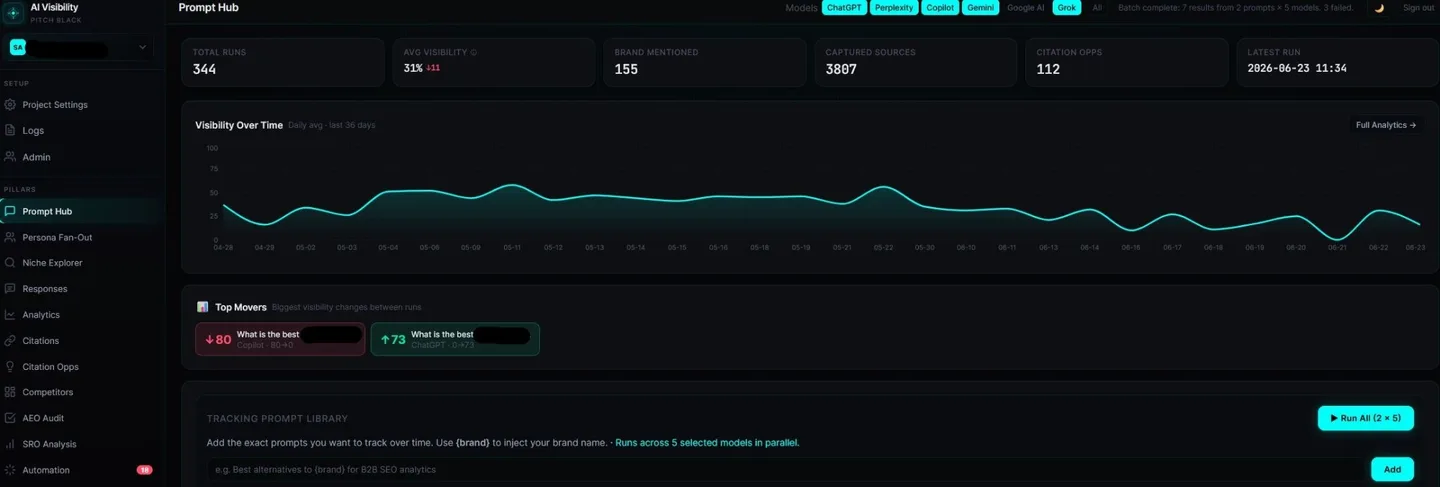
That is the problem we built AI Radar to solve. It is a tool that asks the AI assistants the questions your customers are actually asking, on a schedule, across every major model, and tells you whether your business gets named and how you stack up against your competitors.
Why your normal reporting cannot see this
Your rank tracker tells you where you sit in Google's blue links. Your analytics tell you who landed on your site and what they did. Neither of them can see the moment a potential customer asks Perplexity "who should I use for X" and gets handed three names that may or may not include yours.
This is a genuinely new blind spot. The recommendation happens entirely inside the model. There is no impression to log, no click to attribute, no SERP to screenshot. The first time most businesses find out they are invisible in AI search is when a competitor mentions they are getting leads from it.
AI Radar closes that blind spot the only way it can be closed honestly: by going and asking the models directly, over and over, and recording what they say.
What it actually tracks
The tool runs your chosen prompts across six AI systems: ChatGPT, Gemini, Perplexity, Copilot, Grok and Claude. You add the questions you want to monitor, the real ones your customers would type, and you add the competitors you want to measure yourself against. From there it keeps asking and keeps recording.
A few things matter about how it works, and they are the things most "AI visibility" tools gloss over.
It asks more than once. Ask ChatGPT the same question twice and you can get two different answers. The output is not fixed, so a single check is noise, not data. The only way to get a real signal is to ask many times and look at how often you appear across all those runs. One lucky mention is not visibility. Showing up in eight runs out of ten is.
It measures what the model says, not just what it links. A lot of tools fixate on citations, the little source links some assistants show under an answer. Those are worth watching, but they are not the whole picture, and treating them as the scoreboard is misleading. A model can recommend your business by name with no link attached at all. It can also pull from a page without ever crediting it. So the number that actually matters is whether the model names you in the answer itself, not whether your URL turns up in a footnote. AI Radar is built around the answer, because that is what your customer reads.
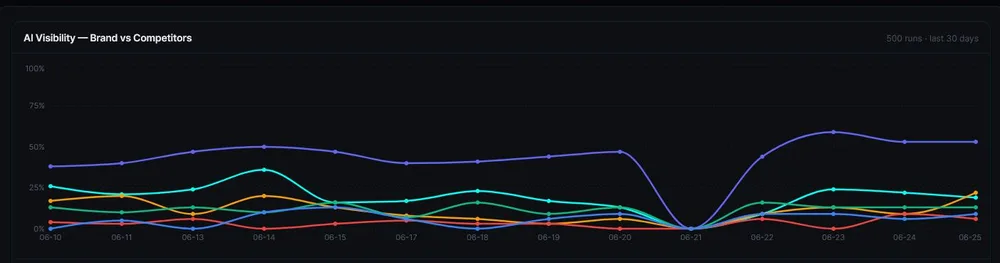
It is comparative. Knowing you appear 40% of the time means very little on its own. Knowing you appear 40% of the time while your main competitor appears 75% of the time tells you exactly where you stand and how much ground there is to make up. The competitor view is the part clients tend to sit up for.
The honest part, because someone has to say it
Here is the bit most vendors in this space will not tell you. There is a hard limit on what anyone can measure about AI search, and pretending otherwise is selling smoke.
We can see what the models say. We can track it precisely, repeatedly, and over time, and that is a real and useful metric. What nobody can see is the machinery underneath: the exact set of sources a model pulled for a given answer, how its training data weighted your brand, or the precise reason it picked your competitor over you on a particular run. That part is a closed box. Any tool claiming to tell you "exactly why you got cited" is claiming to see inside a system that is not visible to anyone outside the company that built it.
So we do not claim it. AI Radar measures the output, the thing that actually affects your business, and tracks how it moves as you do the work to improve it. We treat everything upstream as a signal we are hoping correlates, not as a closed loop we can prove. That is a less impressive sales pitch and a far more truthful one, and in our experience clients would rather have the truthful version.
What you do once you can see the gap
Measurement on its own does not move anything. The point of seeing the gap is to close it, and that is where the actual work starts.
Getting named by AI assistants comes down to a handful of things: being clearly and consistently described as what you are across the web, having content structured so a model can extract and trust it, earning genuine third-party mentions and reviews, and making sure the technical basics let AI crawlers read you in the first place. That is the substance of AI SEO and Generative Engine Optimisation, and it is what we do for clients once AI Radar has shown them exactly where they are starting from.
The nice thing about pairing the two is that you stop guessing. You get a baseline, you do the work, and a few weeks later you can see in the data whether the model is naming you more often than it used to. Not a vanity number, an actual before-and-after on the thing that sends you customers.
Where to start
If you have never checked, start by checking. Open ChatGPT or Gemini right now and ask it for the best provider in your category in your city. See whether you come up. It is a sobering five-minute exercise and it is usually the moment the penny drops.
If you want the version that runs continuously, across all six models, with your competitors tracked alongside you, that is what AI Radar is for. We give every Pitch Black client free access to it, because the measurement and the work that follows go hand in hand, and we would rather you could see the results of that work for yourself.
And if the answer turns out to be that you are nowhere, that is not a disaster. It is a starting line, and it is a far better place to begin than not knowing at all.